How to Respond to We Need to Talk (Without Spiraling)
The 4 most anxiety-inducing words in texting. Why your brain catastrophizes, what they usually actually mean, and response scripts for every sender -- partner, boss, friend, parent.

Four words. That's all it takes to ruin your entire afternoon.
"We need to talk."
Your stomach drops. Your brain immediately starts running through every possible thing you could have done wrong this week, this month, this year. You check the timestamp. You check who sent it. You check if anyone else got the same message. You start drafting a response, delete it, draft another one, delete that too.
You haven't even had the conversation yet and you're already exhausted by it.
You're not being dramatic. This is one of the most universally anxiety-triggering phrases in modern communication, and there's actual science behind why it hits so hard.
Why does your brain go to the worst place?
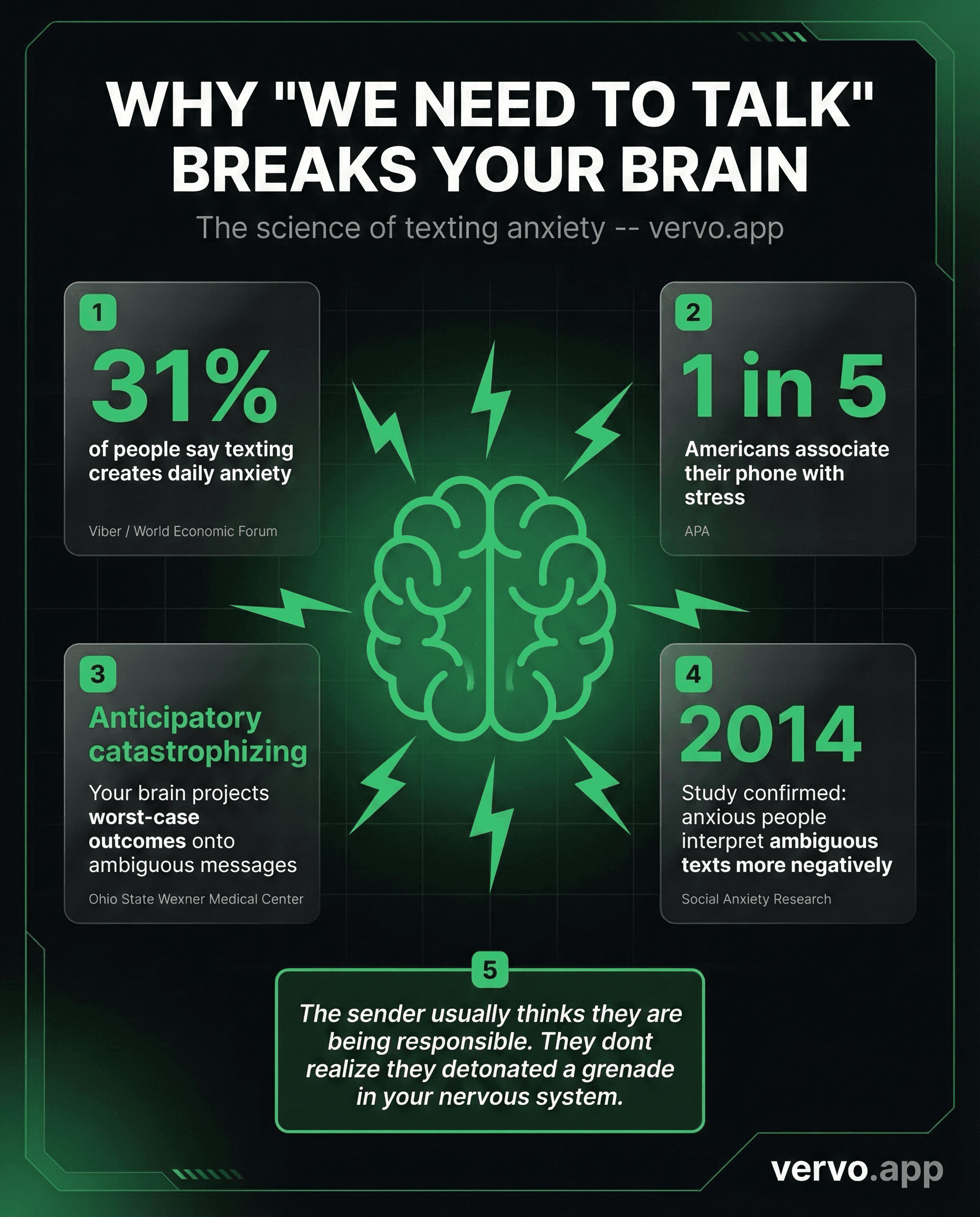
According to a Viber study cited by the World Economic Forum, roughly 31% of people report that texting is a prominent source of daily anxiety. And "we need to talk" is the text equivalent of a fire alarm going off in a quiet room.
The reason it's so destabilizing is something psychologists call anticipatory catastrophizing -- your brain's tendency to project the worst possible outcome onto an ambiguous situation. According to Arianna Galligher, director of the Stress, Trauma and Resilience program at Ohio State University Wexner Medical Center, catastrophic thinking is one of the defining symptoms of anxiety: the belief that the worst outcome isn't just possible but probable.
"The ambiguity and lack of tone or context in this type of message leaves a huge amount of room for interpretation and catastrophizing," says Alex Oliver-Gans, a licensed marriage and family therapist.
A 2014 study on social anxiety found that people with anxiety tendencies were significantly more likely to interpret ambiguous messages negatively -- even when the sender intended no harm. Your brain isn't reading the text. It's reading into the text. And what it finds there is usually worse than reality.
This is the extreme version of overthinking every text you receive. Same mechanism, higher stakes.
What does "we need to talk" usually actually mean?
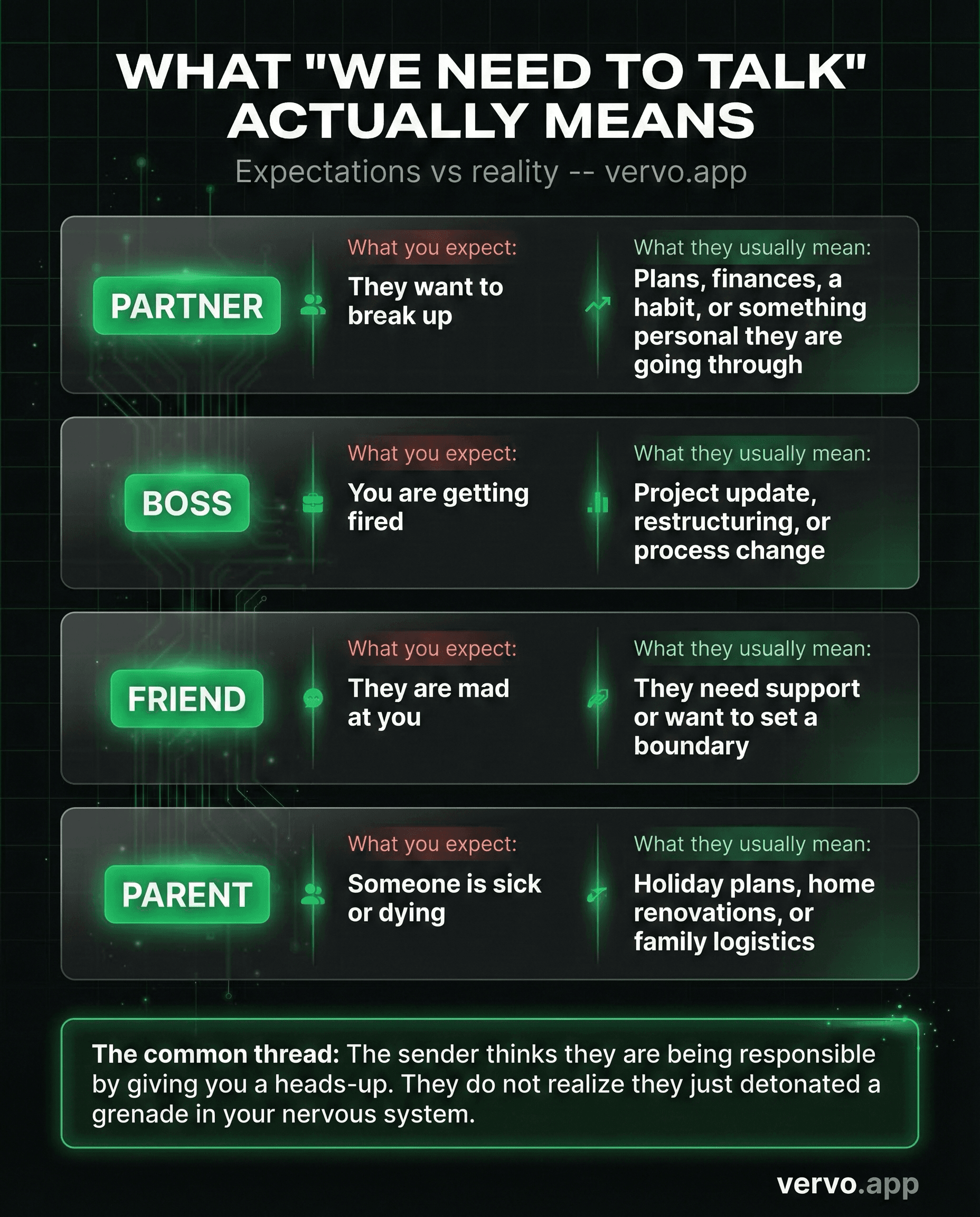
Here's what most people won't tell you: the vast majority of "we need to talk" conversations are not catastrophic. They're often about logistics, boundaries, or something the sender has been meaning to bring up but didn't know how to introduce.
From a partner: Usually about the relationship trajectory -- not a breakup. They want to discuss moving in, finances, a habit that's bothering them, or something they're going through personally. The phrase sounds ominous because it's a verbal doorbell. They're announcing the conversation, not the content.
From a boss: Usually about a project, a restructuring, or a process change. Less often about your performance than you think. Managers use "we need to talk" as a calendar placeholder, not a verdict.
From a friend: Often about something going on in their life that they need support with. Or a boundary they want to set. Friendships have hard conversations too, and this is sometimes the only way they know how to start one.
From a parent: Could be anything from "we're remodeling the kitchen" to "your aunt is sick." Parents tend to use this phrase for conversations they consider serious, which covers a much broader range than you'd expect.
The common thread: the sender usually thinks they're being responsible by giving you a heads-up. They don't realize they've just detonated a grenade in your nervous system.
How should you respond to "we need to talk"?
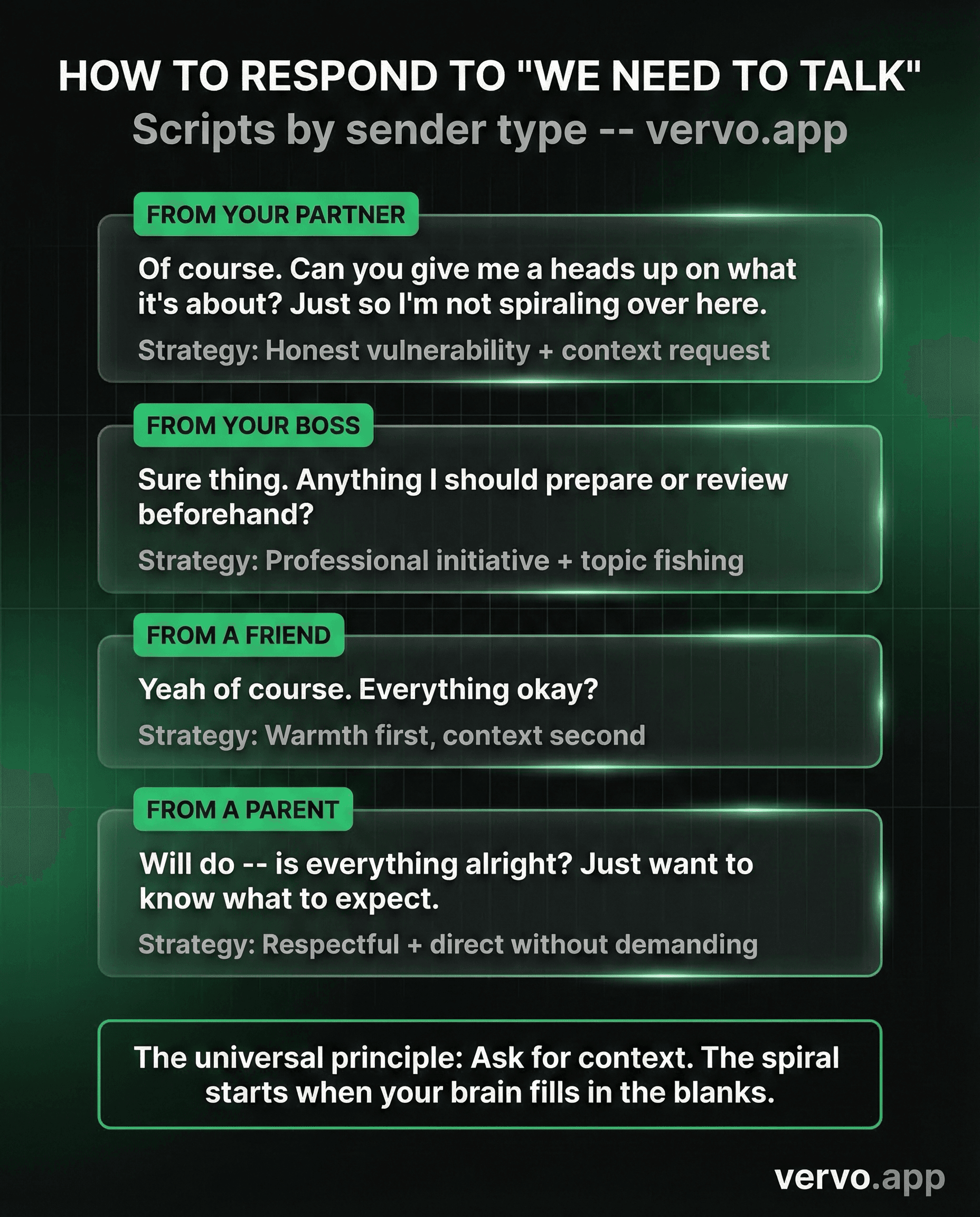
The universal principle: ask for context. Don't sit with the ambiguity. The spiral starts when you have no information and your brain fills in the blanks. Asking one clarifying question stops that cycle immediately.
From your partner
Notice the honesty: "just so I'm not spiraling." Being straightforward about the anxiety the phrase triggers is not weakness. It's communication. And it gives the other person a chance to de-escalate immediately, which most people will do once they realize how it landed.
From your boss
With a boss, "anything I should prepare" is the professional version of asking for context. It signals initiative (you're ready to work) while also fishing for the topic so you can stop imagining worst-case scenarios.
From a friend
"Everything okay?" is warm, open, and non-defensive. It shows you care about them rather than immediately centering your own anxiety. And it often prompts them to clarify the emotional weight of what's coming.
From a parent
Parents, especially, tend to underestimate how alarming this phrasing is. "Is everything alright" paired with "just want to know what to expect" is respectful and direct. It doesn't demand an answer -- it invites one.
What should you NOT do when you get this text?
Don't ignore it. Leaving the message on read doesn't make it go away. It just extends the spiral. Research on repetitive negative thinking (Ehring & Watkins, 2008) found that avoidance is one of the primary accelerants for rumination. Respond, even if briefly.
Don't assume the worst and come in defensive. Responding with "what did I do?" or "oh great, here we go" sets a combative tone before the conversation even starts. If it turns out they wanted to talk about vacation plans, you've just created tension out of nothing.
Don't over-prepare a monologue. You don't know the topic yet. Preparing a defense for something that hasn't been raised is how you end up confessing to things they didn't know about.
Don't send a wall of text. Keep your response short. A question, not an essay. The actual conversation will happen later -- your only job right now is to get information and stop the spiral.
What is the deeper pattern behind this anxiety?
The reason "we need to talk" triggers such an intense response is the same reason you agonize over short replies or read rejection into every slow response. Ambiguity plus attachment equals anxiety. When you care about someone -- romantically, professionally, platonically -- every unclear signal becomes a threat.
That's not a character flaw. Research on social rejection sensitivity shows that people who are more invested in their relationships are more sensitive to ambiguous cues. The anxiety is a byproduct of caring.
But caring doesn't mean you have to suffer. Having a framework -- ask for context, don't assume the worst, respond instead of avoiding -- gives your brain something productive to do instead of spiraling into what-to-text-back paralysis.
When four words send your brain into overdrive, you need a co-pilot. vervo.app gives you three reply options in seconds -- so you can stop spiraling and start responding. Screenshot the message, pick a tone, and send something real before the anxiety writes the script for you.