The Friendship Recession Is a Texting Problem
Americans have fewer close friends than any generation in recorded history. The Surgeon General calls it a public health crisis. The data says texting is part of the cause and part of the cure.
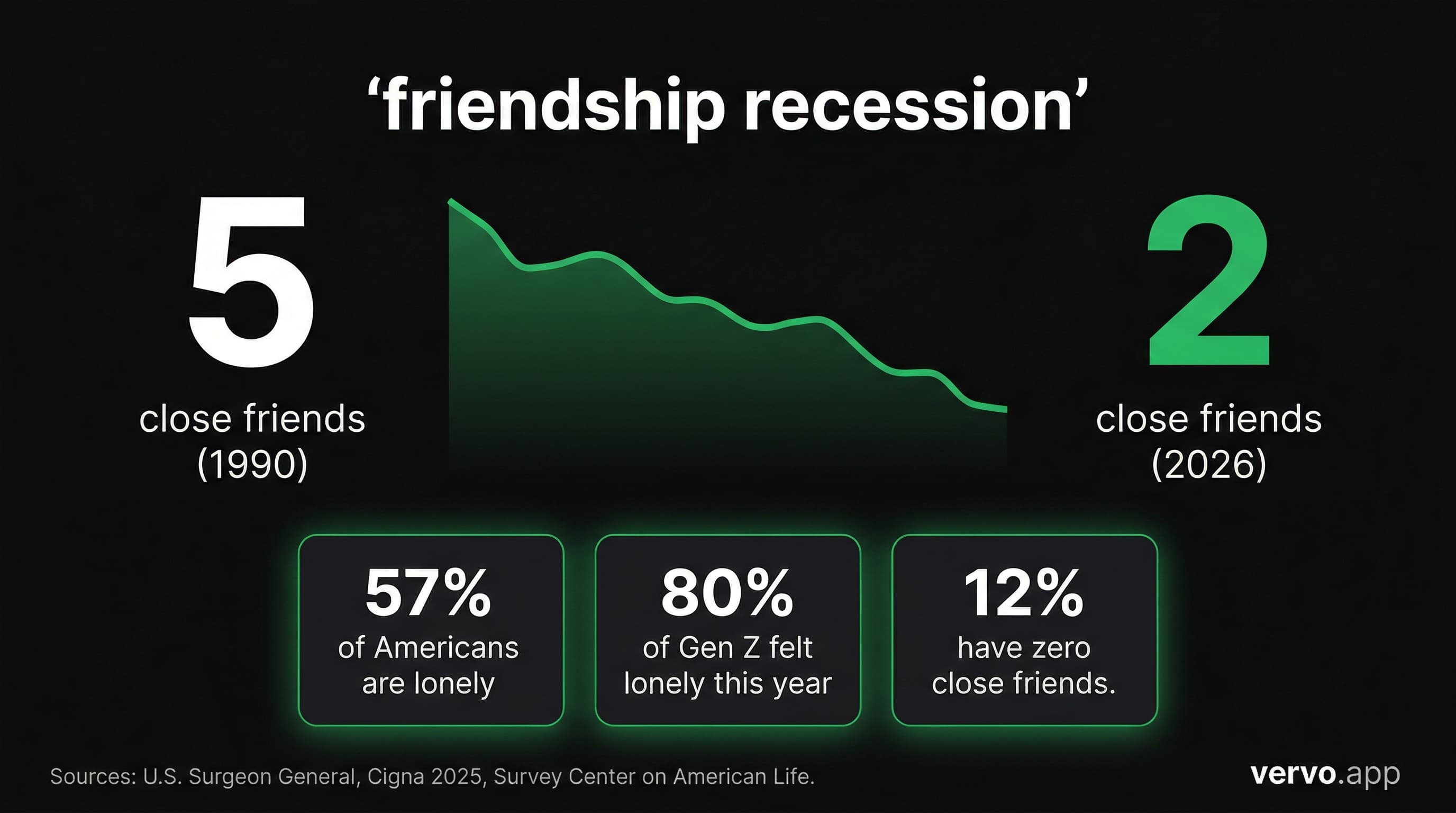
The average American now has two close friends. A generation ago, it was five.
That is not a cultural opinion. It is a data point from the Survey Center on American Life, which tracked friendship patterns across three decades and found that the number of Americans with no close friends has quadrupled since 1990. From 3% to 12%. One in eight adults reports having no one to confide in at all.
The U.S. Surgeon General called it a public health crisis. Not a trend. Not a phase. A crisis with health consequences comparable to smoking 15 cigarettes a day.
The Numbers Behind the Friendship Recession
The data is consistent across every major study.
The Cigna Group's 2025 "Loneliness in America" survey of more than 7,500 U.S. adults found that 57% of Americans are lonely. Younger generations report the highest rates despite having the most communication tools in human history.
A 2024 study from the 4As representing 1,821 Gen Z respondents found that 80% had felt lonely in the past 12 months. Among baby boomers, that number is 45%. The generation with the most access to instant communication is also the loneliest generation ever measured.
For men, the numbers are worse. The percentage of men with at least six close friends fell by half since 1990, from 55% to 27%. One in five unmarried men reports having no close friends at all.
The Surgeon General's 82-page advisory laid out the health consequences. Social isolation increases the risk of premature death by 29%. It raises the risk of heart disease by 29% and stroke by 32%. Among older adults, loneliness increases the risk of dementia by 50%. The economic cost is $6.7 billion in excess Medicare spending annually, plus an estimated $154 billion in stress-related workplace absences.
These are not abstract statistics. This is a generation that can reach anyone on earth in seconds but cannot figure out how to say "I miss you" to the person across town.
Where Friendships Actually Die
Friendships do not end with a fight. They end with silence.
The Bumble 2025 friendship survey found that 52% of adults had not made a new friend in the past year, despite 60% saying they wanted to. The intention is there. The execution is not.
The gap between wanting to connect and actually connecting is where most friendships deteriorate. It is the "we should hang out" text that never gets a follow-up. It is the birthday message you meant to send but forgot. It is the check-in you drafted in your head but never typed.
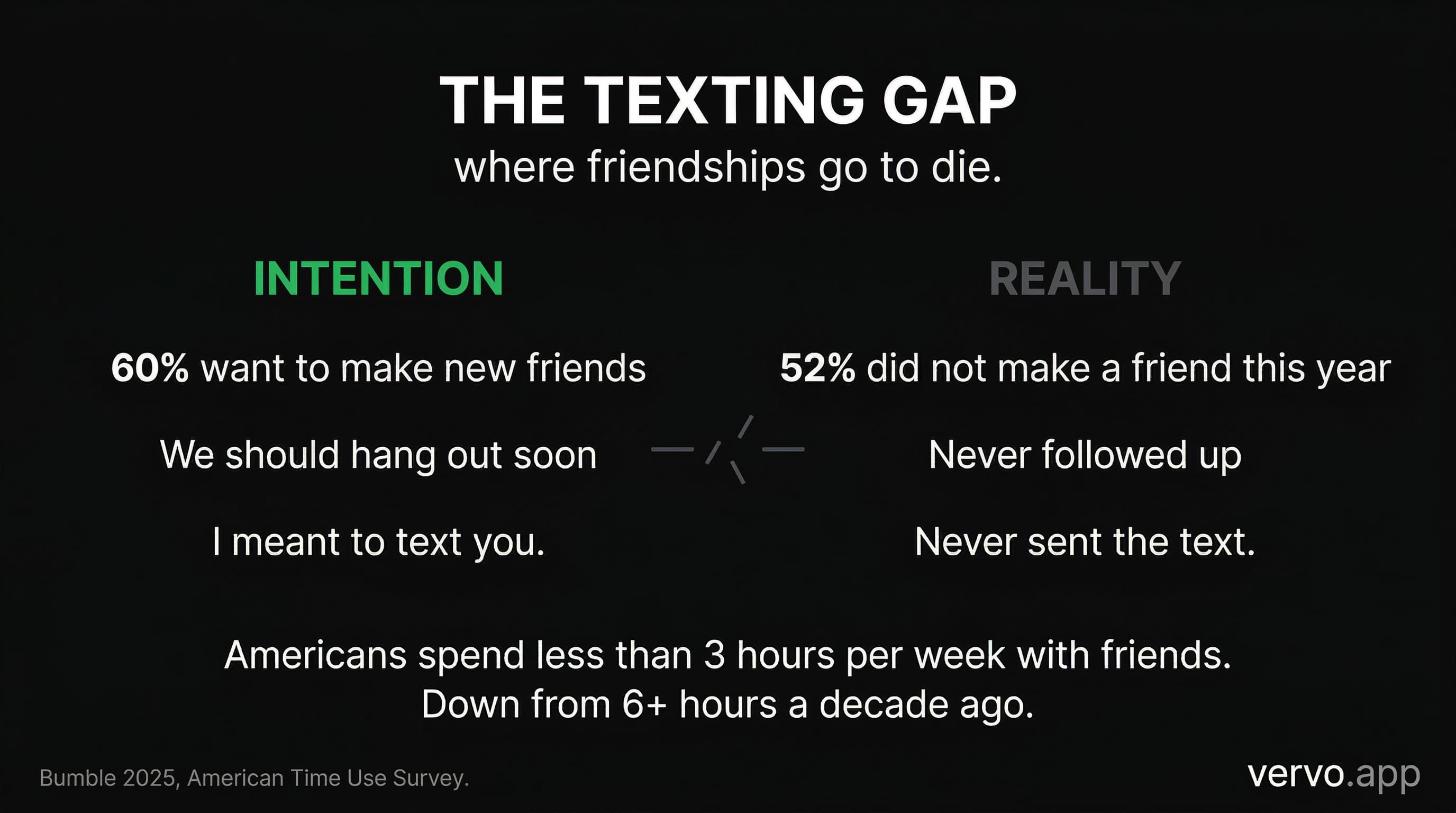
Americans now spend fewer than three hours per week with friends, down from over six hours a decade ago. That decline tracks almost perfectly with the rise of text-based communication as the primary mode of staying in touch.
The problem is not that people text instead of meeting in person. The problem is that texting creates the illusion of maintenance without the substance. Liking someone's Instagram story feels like staying connected. It is not. Sending a meme feels like reaching out. It is not. Reacting to a post with a heart feels like saying "I care about you." It does not carry the same weight.
Real friendship maintenance requires real words directed at a real person. "How are you actually doing" beats a heart reaction every time.
The 93% Problem
Communication researcher Albert Mehrabian established that 93% of emotional meaning in conversation comes from nonverbal cues. Tone of voice. Facial expression. Body language. Only 7% comes from the actual words.
Texting strips away 93% of the signal. What remains is words on a screen, open to interpretation, filtered through whatever mood the reader happens to be in at the moment.
This is why texting feels harder than talking in person. In person, your smile communicates warmth. Your tone communicates sincerity. Your presence communicates priority. In text, you have twenty words and a punctuation mark. The entire emotional load falls on a medium that was never designed to carry it.
The result is a generation that defaults to low-effort communication because high-effort communication feels too risky. The stakes of saying the wrong thing in text feel higher than in person, because there is no tone or expression to soften the landing. So people say nothing. Or they say "lol." Or they send a thumbs up. And the friendship slowly starves.
Why Social Media Makes It Worse
Social media creates what researchers call "unsatisfying connectedness." You know what your friends ate for lunch. You know where they went on vacation. You know their political opinions. But you do not know how they are actually feeling.
The 4As study found that Gen Z has a higher proportion of online-only connections than any previous generation. These connections generate social media engagement but not emotional depth. There are lots of likes and comments, but no real vulnerability.
Harvard's Graduate School of Education research on loneliness identified a critical distinction. Loneliness is not about the quantity of connections. It is about the quality. You can have 2,000 followers and zero people who would notice if you disappeared for a week.
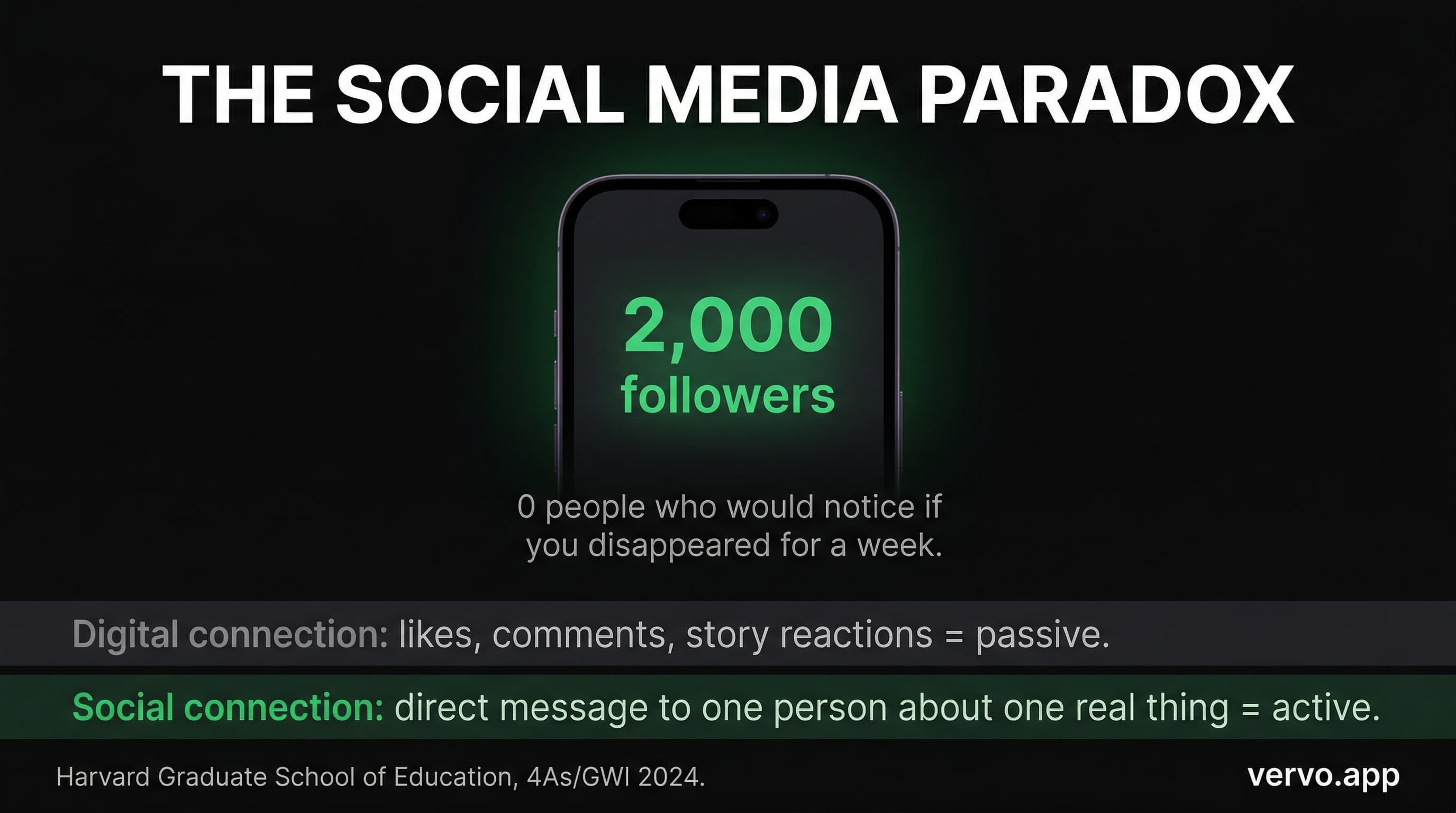
The Surgeon General's advisory called for a distinction between digital connection and social connection. Digital connection is passive. Social connection requires active engagement. Watching someone's story is digital connection. Texting them "that looked fun, I miss hanging out with you" is social connection.
The tool is not the problem. How people use the tool is the problem.
What the Research Says Actually Works
The Surgeon General's framework for addressing the loneliness crisis includes several recommendations that boil down to one principle. Initiate more direct, meaningful one-on-one communication.
Not group chats. Not social media comments. Not meme exchanges. Direct messages to specific people about specific things.
Research from the Harvard Happiness Lab found that the quality of relationships is the single strongest predictor of well-being. Stronger than income, stronger than career success, stronger than physical health. And relationship quality depends on the frequency and depth of communication.
The practical version of this is simple. Send one real text per day to someone you care about. Not a meme. Not a reaction. A text that says something specific and genuine. "Thinking about you." "That thing you said last week stuck with me." "How is the new job going for real?"
The friendship recession is not a problem that requires more apps, more platforms, or more group chats. It requires better use of the tools that already exist. One honest text to one specific person, sent today instead of "someday."
If composing that text feels harder than it should, that is normal. It is the same choice overload that makes every important text feel impossible. Vervo can help. Screenshot the conversation, get three reply options that sound like you, and send the one that fits. The friendship does not need a perfect message. It needs any message at all.
Sources
- U.S. Surgeon General. "Our Epidemic of Loneliness and Isolation." Advisory, 82 pages, 2023.
- The Cigna Group / Evernorth Research Institute. "Loneliness in America 2025." Survey of 7,500+ U.S. adults, 2025.
- Survey Center on American Life. "American Men Suffer a Friendship Recession." American Enterprise Institute, 2021-2024.
- 4As / GWI. "Digitally Connected Yet Deeply Lonely." Survey of 1,821 Gen Z respondents worldwide, 2024.
- Bumble. "Friendship Survey 2025." 2025.
- Harvard Graduate School of Education. "What Is Causing Our Epidemic of Loneliness and How Can We Fix It?" October 2024.
- Pew Research Center. "Americans and Their Close Friends." October 2023.
- Albert Mehrabian. "Silent Messages: Implicit Communication of Emotions and Attitudes." Wadsworth Publishing, 1981.