Your Text Was Fine. They Read It Wrong.
51% of people say their written messages are regularly misinterpreted. The science behind why your perfectly reasonable text sounds angry, cold, or passive-aggressive to the person reading it.
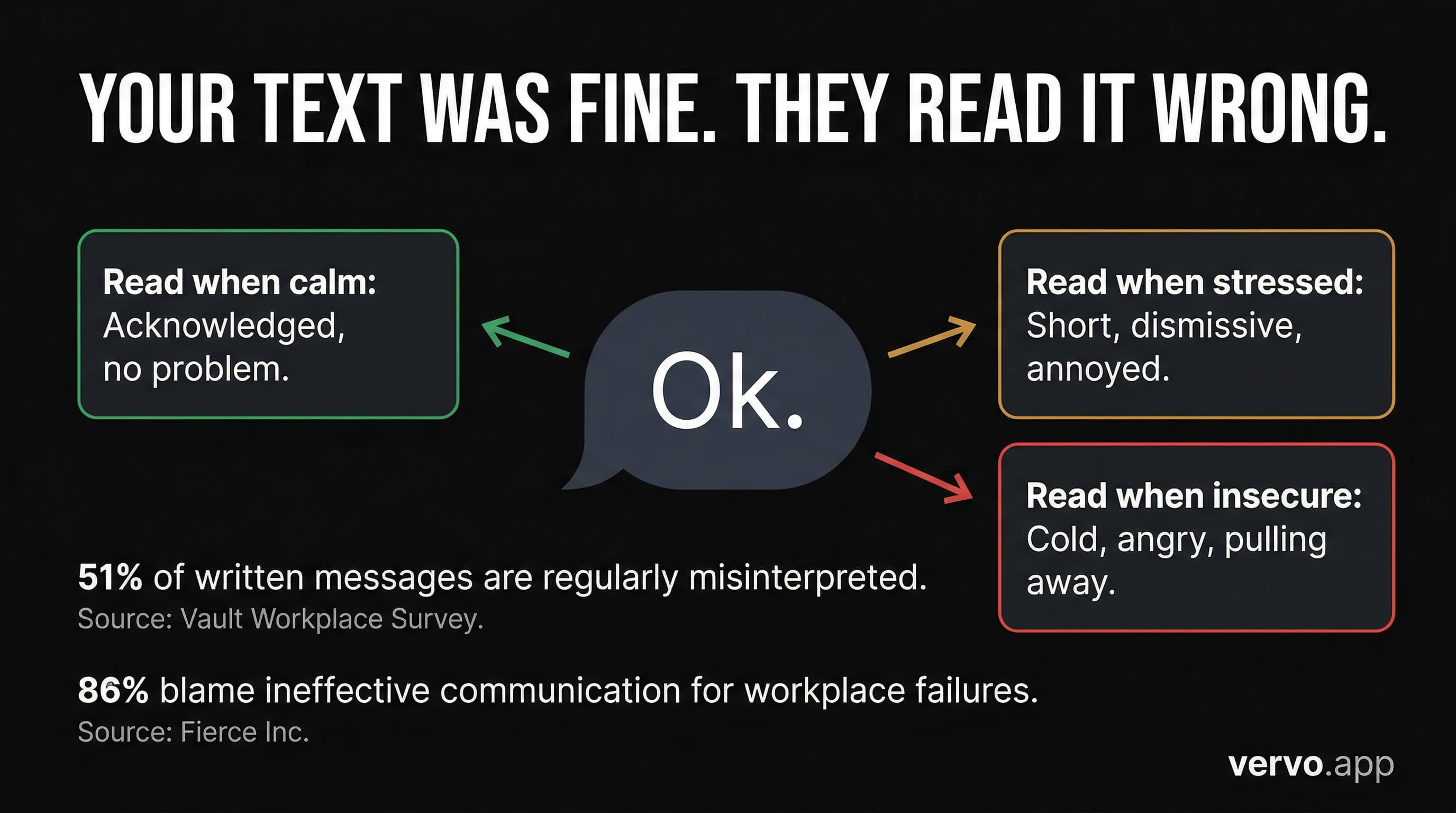
You sent "Ok." They read it as furious.
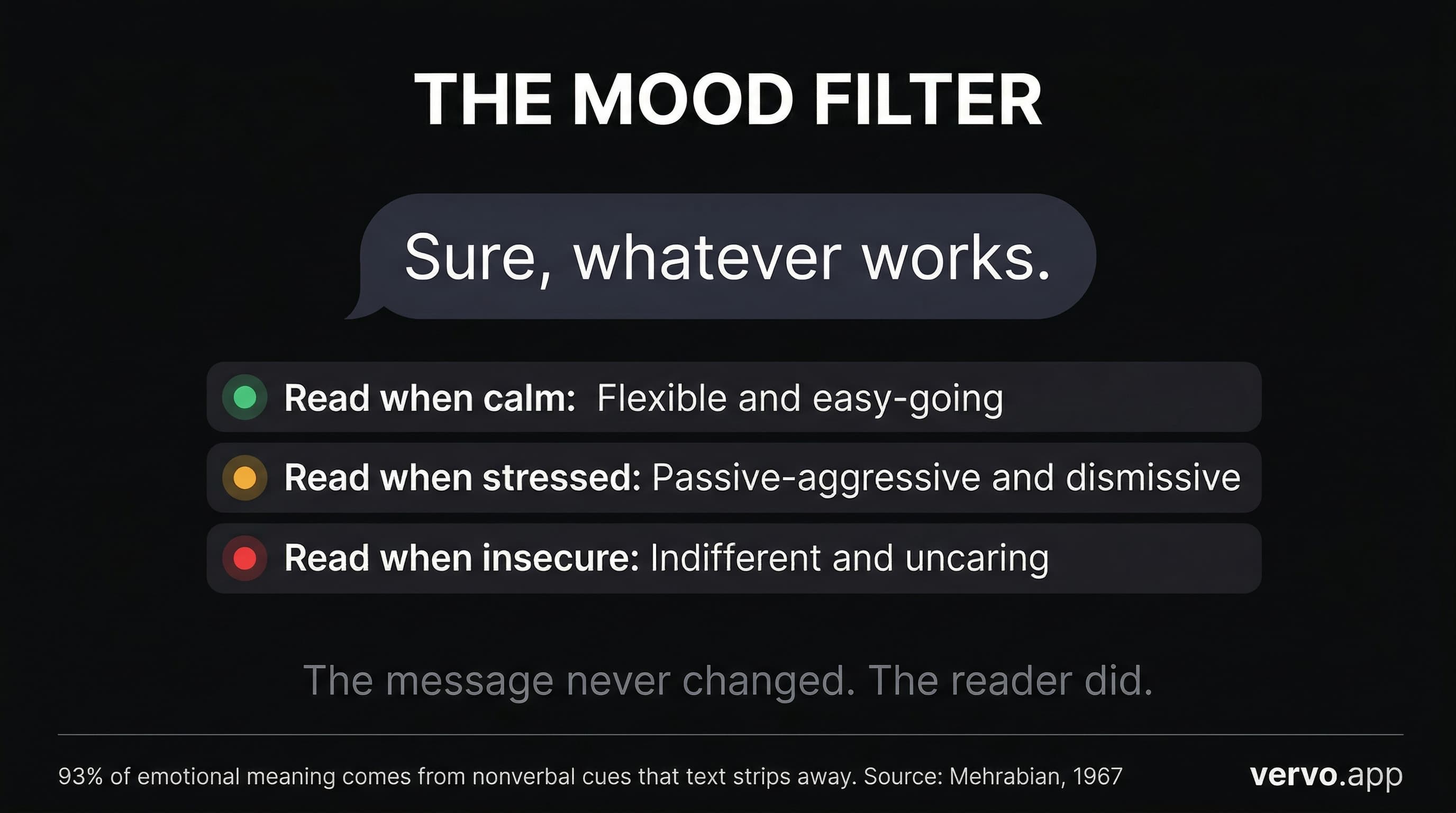
You sent "Sure, whatever works." They read it as passive-aggressive.
You sent "Can we talk?" They spent 45 minutes convinced you were breaking up with them.
Your text was fine. They read it wrong. And according to a Vault study of workplace communication, this happens to 51% of people on a regular basis. More than half of all written messages are misinterpreted, usually in a negative direction.
The problem is not bad writing. The problem is that text-based communication is structurally incapable of carrying emotional nuance. And everyone is acting as if it can.
The 93% Gap
In 1967, psychologist Albert Mehrabian conducted research on how people interpret emotional meaning in communication. His finding, replicated and referenced across decades of subsequent research, was that 93% of emotional meaning comes from nonverbal channels. Tone of voice accounts for 38%. Facial expression and body language account for 55%. The actual words account for 7%.
Texting eliminates 93% of the signal.
When someone says "I'm fine" in person, you can hear whether they mean it. Their voice tells you. Their face tells you. Their posture tells you. When someone texts "I'm fine," you have nothing but two words and whatever emotional filter your brain applies.
The filter is the problem. Research in interpersonal communication shows that people systematically fill emotional gaps with assumptions. And those assumptions are shaped by the reader's current emotional state, not the writer's intent.
If you are anxious, you read neutral messages as threatening. If you are insecure, you read short messages as rejection. If you are stressed, you read straightforward messages as demanding. The message does not change. The reader does.
The Period Problem
A 2016 study from Binghamton University found that text messages ending with a period are perceived as less sincere than messages without one. "Sounds good" reads as agreeable. "Sounds good." reads as annoyed.
This is not rational behavior. A period is a grammatical mark that indicates the end of a sentence. It has no emotional content. But in the context of texting, where full punctuation is optional, including a period signals formality. And formality signals distance. And distance signals something is wrong.
The same dynamic applies across other punctuation. An exclamation point signals enthusiasm. Its absence signals its absence. "Thanks!" reads as grateful. "Thanks" reads as neutral. "Thanks." reads as resentful. Three versions of the same word, carrying three different emotional charges, based entirely on a punctuation mark that grammar textbooks would call optional.
Pumble's 2026 workplace communication research found that 26% of employees believe there is a risk of misunderstanding when interpreting emojis or chat abbreviations at work. A thumbs-up from a Gen X manager means "acknowledged." A thumbs-up from a Gen Z employee might mean the same thing, or it might be read by the Gen X manager as dismissive. Neither interpretation is wrong. Both are incomplete.
Why Mood Is the Real Author
Fierce, Inc. surveyed over 1,400 employees, corporate executives, and educators and found that 86% believe ineffective communication is the underlying cause of workplace failures. The cost runs between $10,000 and $55,000 per employee per year in lost productivity.
But the failures are not happening because people write bad messages. They are happening because the reader's emotional state rewrites every message before the conscious mind processes it.
Poppulo's 2026 internal communication trends report identified the core issue. The biggest risk to organizations is not misinformation. It is misunderstanding. The challenge is helping people create clarity and context from the avalanche of messages they receive daily.
Context is the key word. In person, context is automatic. You can see whether someone is smiling or frowning when they say something. In text, context must be deliberately built. And most people do not build it because they assume the reader will interpret the message the same way they intended it.
This assumption is wrong 51% of the time.
The Escalation Pattern
Digital conflict follows a predictable pattern. A message is sent with one intention. It is received with a different interpretation. The receiver responds based on their interpretation. The original sender, confused by the response, escalates. Each round adds another layer of misunderstanding.
Research from One Alkaline Life on digital conflict resolution found that arguments that begin in text rarely resolve in text. Written messages lack the real-time feedback loops that prevent escalation in face-to-face conversation. In person, you can see confusion forming on someone's face and clarify before it becomes conflict. In text, the confusion becomes a reply becomes a counter-reply becomes a screenshot sent to three friends for validation.
The 2026 workplace conflict trends report from the Mediation and Workplace Initiative found an emerging pattern. Conflict is surfacing later, not sooner. Leaders encounter it only after frustration has accumulated and relationships are already strained. Hybrid work environments mask early warning signs. Fewer informal check-ins and more asynchronous communication make it easier for concerns to remain unspoken or for silence to be mistaken for alignment.
The text that started the conflict was probably fine. But by the time anyone addresses it, three rounds of misinterpretation have passed and the original meaning is buried.
How to Write Texts That Cannot Be Misread
The research points to several practices that reduce misinterpretation.
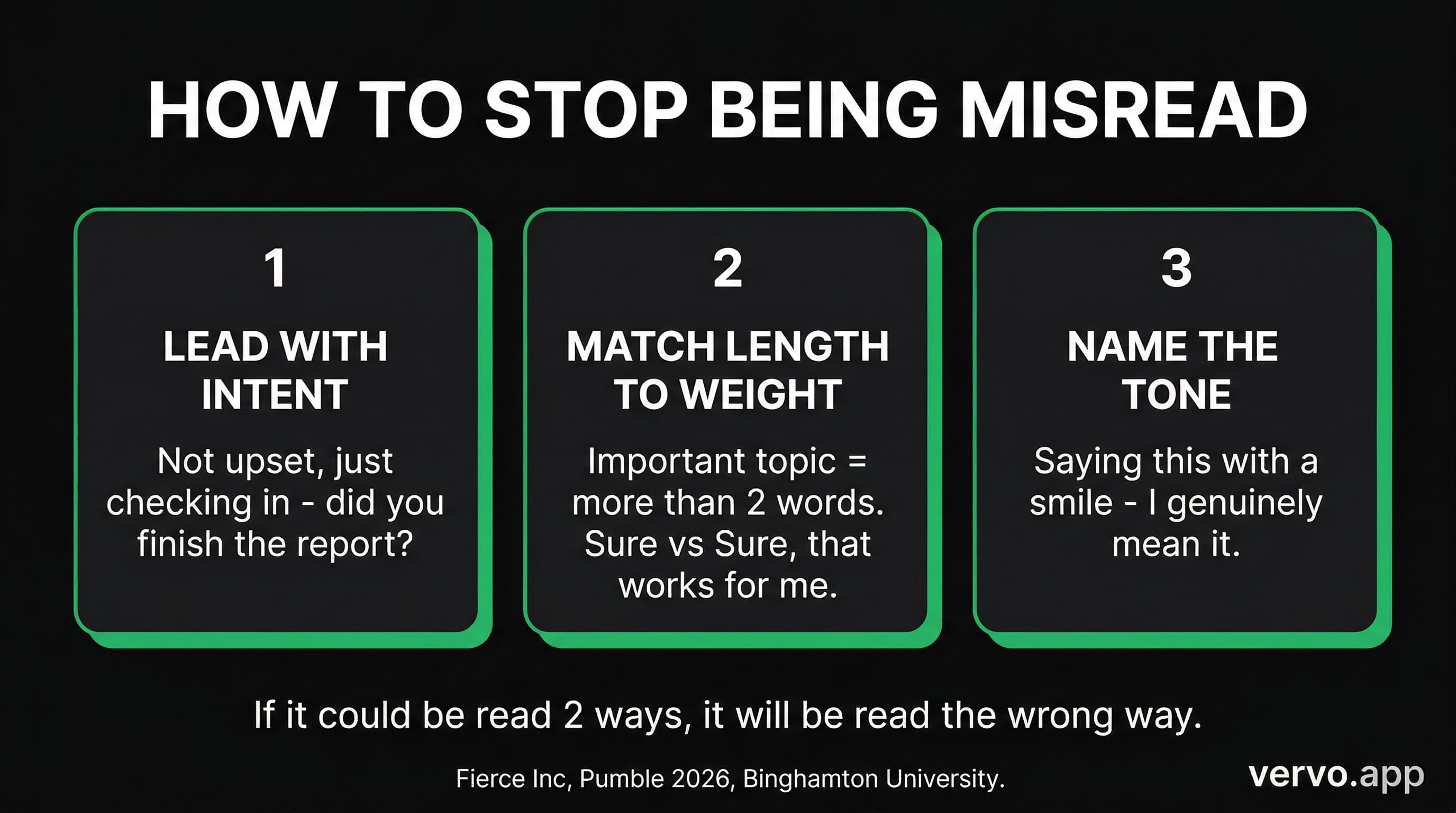
Lead with intent. Before the content of your message, state your emotional intent. "Not upset, just checking in" before "Did you finish the report?" "Genuinely asking, not criticizing" before "Why did you choose that approach?" This is redundant in person because your tone carries the intent. In text, you have to spell it out.
Match length to weight. Short messages about important topics get misread. If the topic matters, write more than two words. "Sure" in response to "Can we change the project deadline?" carries no emotional information. "Sure, that works for me. I was thinking the same thing" carries warmth and agreement.
Name the tone. If your message could be read multiple ways, add a tone indicator. This does not mean adding emojis. It means adding a short phrase that eliminates ambiguity. "I mean this warmly" or "saying this with a smile" or "genuinely not sarcastic" removes the reader's need to guess.
Know when to call. If a text conversation has required more than three rounds of clarification, switch to a phone call or voice note. The 93% of emotional information that text strips away is available instantly in voice. What takes twenty texts to clarify takes thirty seconds on a call.
The Real Cost of Misread Texts
Every misread text has a cost. In the workplace, it is productivity and trust. In relationships, it is closeness and security. In friendships, it is the slow erosion that comes from never quite understanding what the other person meant.
The 51% misinterpretation rate means roughly half of all important texts are landing differently than intended. Half of the conversations you think went fine actually left the other person confused, hurt, or annoyed. Half of the conversations you thought went badly were probably fine on the other end.
The solution is not to stop texting. Texting is how the world communicates. The solution is to text with the awareness that your words are arriving without tone, without context, and without the 93% of emotional information that makes in-person communication feel natural.
If writing the right words feels harder than it should, Vervo can help. Screenshot the conversation, see three reply options that match different tones, and pick the one that carries the emotion you actually intend. The text is not the problem. The tone gap is the problem. Closing that gap is how you stop being misread.
Sources
- Vault. "Workplace Communication Survey: Email Tone Misperception." 51% misperception rate finding.
- Fierce, Inc. "Survey of Workplace Communication Failures." 1,400+ employees, executives, and educators. 86% finding.
- Albert Mehrabian. "Silent Messages: Implicit Communication of Emotions and Attitudes." Wadsworth Publishing, 1981.
- Binghamton University. "Texting Insincerely: The Role of the Period in Text Messaging." Celia Klin et al., Computers in Human Behavior, 2016.
- Pumble. "Workplace Communication Statistics for 2026." 26% emoji misunderstanding finding.
- Poppulo. "Internal Communication Trends 2026." Misunderstanding as biggest organizational risk.
- Mediation and Workplace Initiative (MWI). "Workplace Conflict Trends in 2026."
- One Alkaline Life. "Conflict Without Closure: How Digital Communication Changed the Way Adults Handle Disagreements."