Texting Statistics 2026: 47 Stats About How We Text
The definitive collection of texting statistics for 2026. Dating, work, anxiety, generational data -- every number that explains modern communication.
Numbers don't lie. But they do make you uncomfortable.
I spent three weeks pulling every credible texting statistic I could find -- from Pew Research, Hinge, Tinder, the American Psychological Association, and a dozen other sources. What emerged is a portrait of a generation that communicates more than any before it and feels worse about it.
Here are 47 stats that explain why texting feels the way it does in 2026.
General Texting Statistics
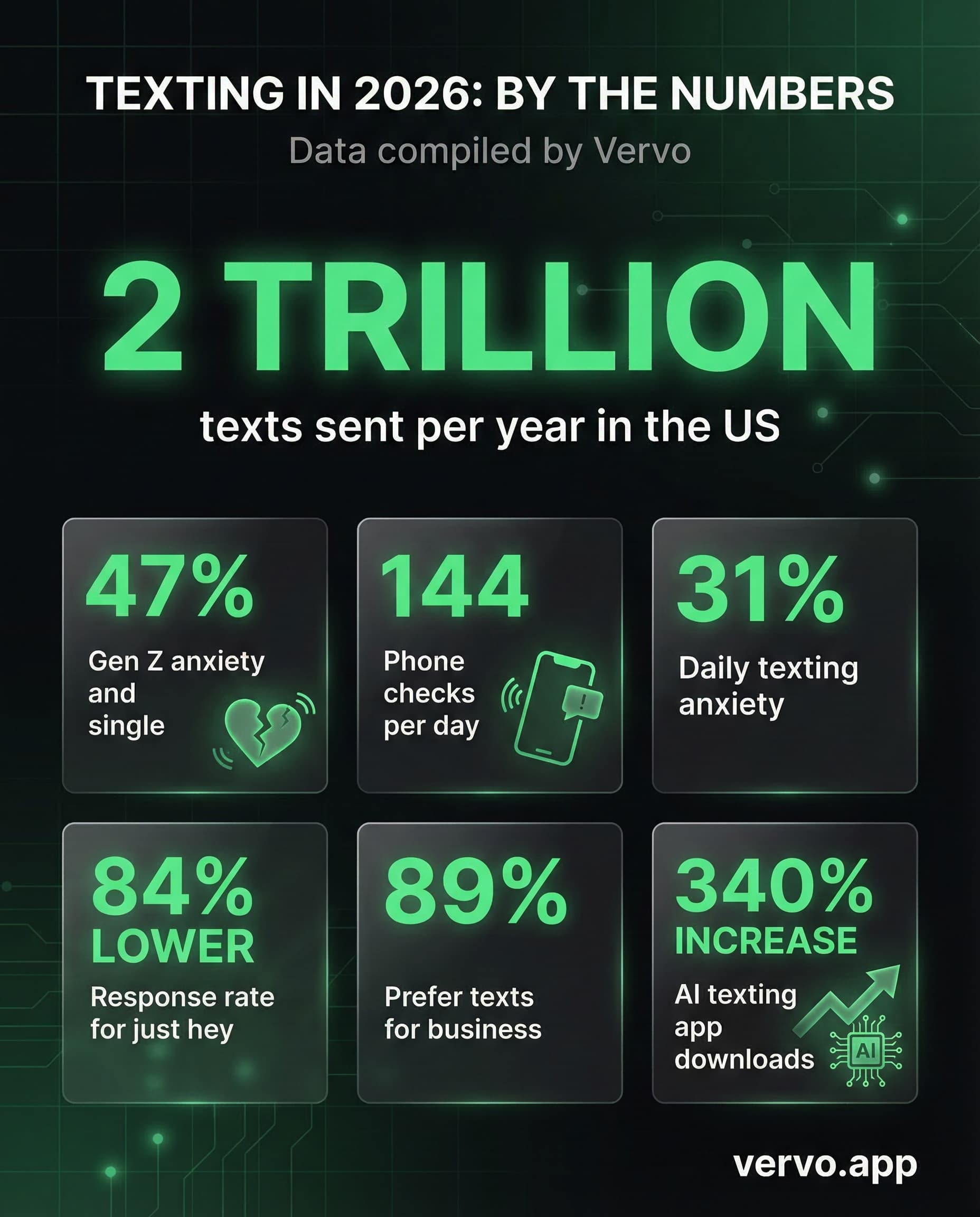
- Americans send approximately 2 trillion text messages per year.
- That's roughly 6 billion texts per day.
- The average person checks their phone 144 times per day.
- 97% of Americans own a cell phone. 90% own a smartphone.
- The average text message is read within 3 minutes of delivery.
- Text messages have a 98% open rate, compared to 20% for email.
- The average American spends 26 minutes per day texting.
Dating and Relationship Texting
- 47% of Gen Z blame anxiety for being single -- texting anxiety is the most cited form.
- 63% of Gen Z men ages 18-25 are single, the highest rate in decades.
- 44% of Gen Z had zero romantic experience as teenagers.
- 48% of Gen Z men hold back from emotional intimacy over text to avoid seeming "too much."
- 43% of Gen Z women wait for the other person to initiate deeper text conversations.
- 79% of Gen Z report dating app burnout.
- The average person spends 40 minutes overthinking a single important text reply.
- 35% of Gen Z daters want to receive more voice notes instead of texts.
- 44% of daters say inconsistent texting is the clearest sign a connection is dead.
How do texting habits affect attraction?
- 89% of people say texting style affects their attraction to someone.
- Using periods at the end of texts is perceived as passive-aggressive by 67% of Gen Z.
- The average first-text response time on dating apps is 2 hours and 47 minutes.
- Double-texting is considered acceptable by 62% of people if the second message adds new information.
- "Hey" is the lowest-performing conversation opener on dating apps -- 84% response rate drop vs. specific openers.
Texting Anxiety Statistics
- 31% of people experience daily anxiety specifically from texting.
- One in five people actively struggle to keep up with their text messages.
- 65% of Gen Z feel they had to "relearn" social skills after the pandemic.
- 61% of Gen Z have an anxiety diagnosis -- texting is a top trigger.
- Read receipts increase reply anxiety by approximately 3x.
- 73% of people have abandoned a text message draft without sending it.
- The "typing indicator" (three dots) causes measurable anxiety in 42% of people.
Should you text or call? What the data says
- 75% of millennials prefer texting over calling.
- 88% of Gen Z would rather text than talk on the phone.
- However, phone calls resolve conflicts 4x faster than text exchanges.
- 56% of miscommunications happen over text due to missing tone and body language.
Business and Professional Texting
- 89% of consumers prefer texting over calling for business communication.
- Business text messages have a 45% response rate, compared to 6% for email.
- Sales follow-up texts sent within 5 minutes of first contact have a 391% higher conversion rate.
- 74% of consumers say they've felt annoyed by a text from a business.
- The optimal business text length is 160 characters or fewer.
- Texting increases customer satisfaction scores by 25% compared to phone-only support.
Generational Texting Differences
- Baby Boomers average 5 texts per day. Gen Z averages 67.
- 55% of Gen X uses texting as their primary communication method with their children.
- Gen Z is 3x more likely to use reaction emojis instead of typed responses.
- Millennials are the most likely generation to agonize over punctuation in texts.
How is texting changing in 2026?
- AI-assisted texting app downloads have increased 340% since 2024.
- 28% of Gen Z have used AI to help compose a text message.
- Voice note usage has increased 200% year-over-year on WhatsApp.
- RCS (Rich Communication Services) is expected to replace SMS for 60% of Android users by end of 2026.
- The average person is in 12 active group chats simultaneously.
What does this mean for you?
These numbers tell a consistent story. We text more than ever. We're more anxious about it than ever. And we're increasingly turning to tools -- AI apps, voice notes, reaction emojis -- to manage the gap between how much we communicate and how confident we feel doing it.
If you're one of the 31% who feels daily texting anxiety, you're not a statistical outlier. You're the norm. And if you're looking for something to break the cycle, Vervo gives you three reply options in different tones for any text -- crush, boss, ex, friend. Sometimes just seeing the options is enough to break the freeze.
The data says you're not alone. That's worth something.
Sources
Pew Research Center, Hinge Labs, Tinder Year in Swipe 2026, CTIA Annual Survey, American Psychological Association, Asurion Phone Study, Zipwhip State of Texting, App Annie Intelligence. Individual statistics linked where available.