How to Ask for a Raise Over Text (Without Sounding Desperate)
Your boss texts more than talks. Here is how to bring up a raise over text without making it weird, plus scripts that actually work.
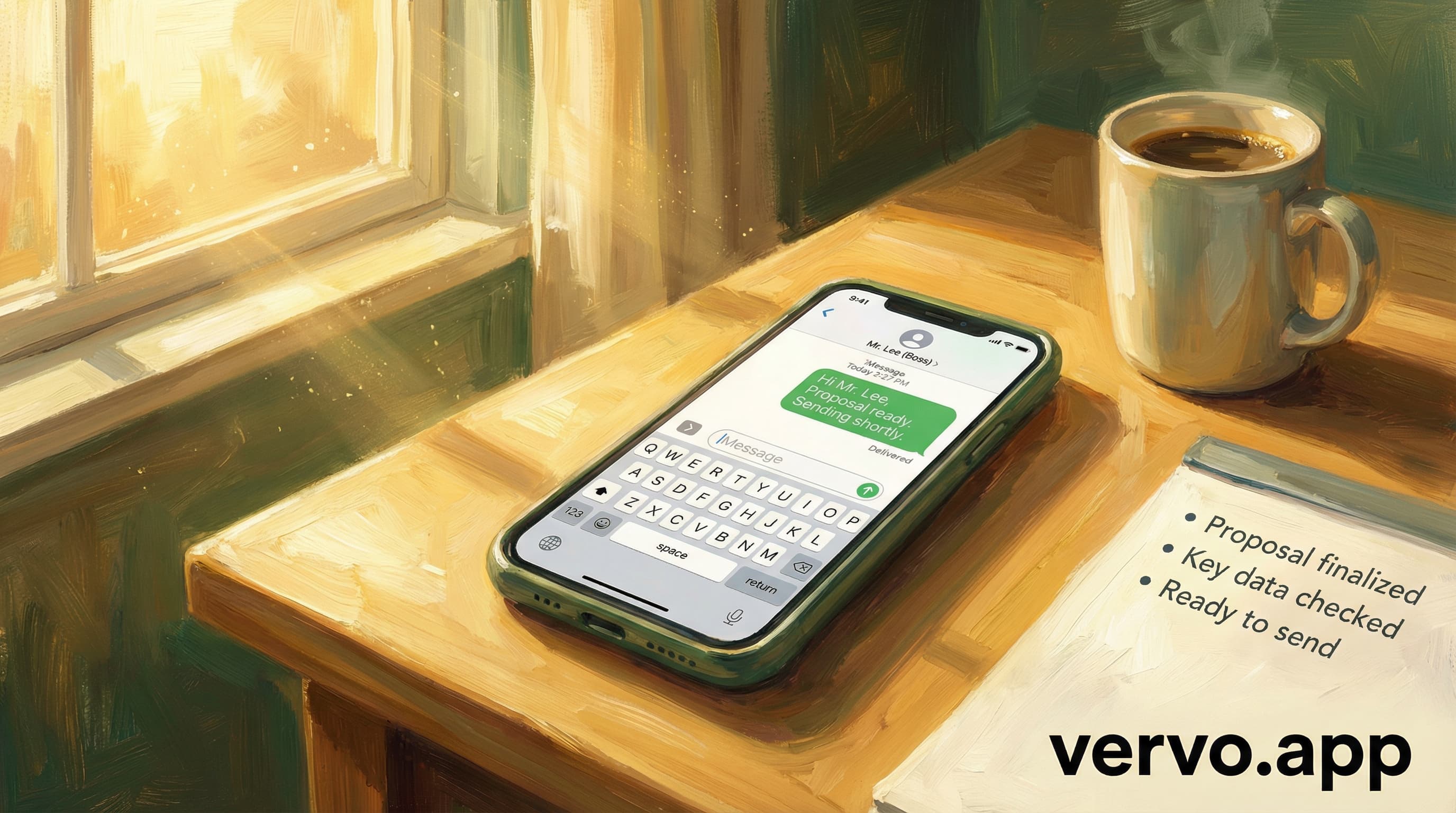
You deserve a raise. You know it. Your boss probably knows it too. But the conversation never happens. Because your boss lives on text, hates meetings, and the idea of bringing up money in a message thread feels somewhere between awkward and career-ending.
So you wait. You tell yourself you'll bring it up "at the right time." Months pass. The right time never shows up.
Here's the thing about asking for a raise over text: it's not the format that makes it scary. It's the ask itself. The text is just the delivery mechanism for a conversation you've been avoiding. And if text is how your boss communicates, and if that's the culture of your workplace, then text is where the conversation belongs.
Let's talk about how to do this without spiraling into a classic overthinking texts situation where you draft seventeen versions and send none of them.
Should You Actually Ask for a Raise Over Text?
Short answer: probably not directly. But you should absolutely start the conversation over text.
There's a difference between "Hey, I think I deserve more money, here's why" in a message thread and "Hey, I'd love to find 15 minutes to talk about my compensation. When's good for you?"
The first one puts your boss on the spot. They're reading it between meetings, or on their commute, or while eating lunch at their desk. They don't have time to think. They're likely to default to "not right now" just to close the loop.
The second one asks for a conversation. It signals seriousness without forcing an immediate answer. It gives your boss time to prepare. Which, counterintuitively, works in your favor. A boss who's prepared is a boss who's more likely to say yes.
90% of the time, the text is the opener. The raise conversation happens on a call or in person.
When Is It Okay to Actually Negotiate Over Text?
There are exceptions. If your workplace is fully remote and async, if your boss has explicitly said he prefers written communication, or if you've already had a verbal conversation and you're following up in writing. Then text isn't just acceptable. It's expected.
Here's what that looks like:
That's a green light. Now you're not ambushing anyone. You're continuing a dialogue.
The ZeroBounce 2025 workplace report found that Gen Z employees increasingly prefer text and async communication for even high-stakes conversations. If that's your workplace culture, lean into it. You're not being unprofessional. You're meeting your boss where he is.
What's the Best Time to Send the Text?
Timing matters more than perfect wording. You can nail every word and still get a "now's not a good time" if you send it at the wrong moment.
Good timing:
- Right after you delivered a successful project
- After a performance review where you got positive feedback
- After taking on new responsibilities without a title or pay adjustment
- When the company is doing well (new funding, strong quarter, expansion)
Bad timing:
- During layoffs or budget cuts
- Right after your boss got bad news
- Monday morning when everyone is drowning
- Friday afternoon when everyone is mentally gone
The pattern here: text when your value is top of mind, and when your boss has mental bandwidth to actually consider the request. If you're the person who just saved a client relationship or shipped a big feature, that's your window.
How Do You Word the Text Itself?
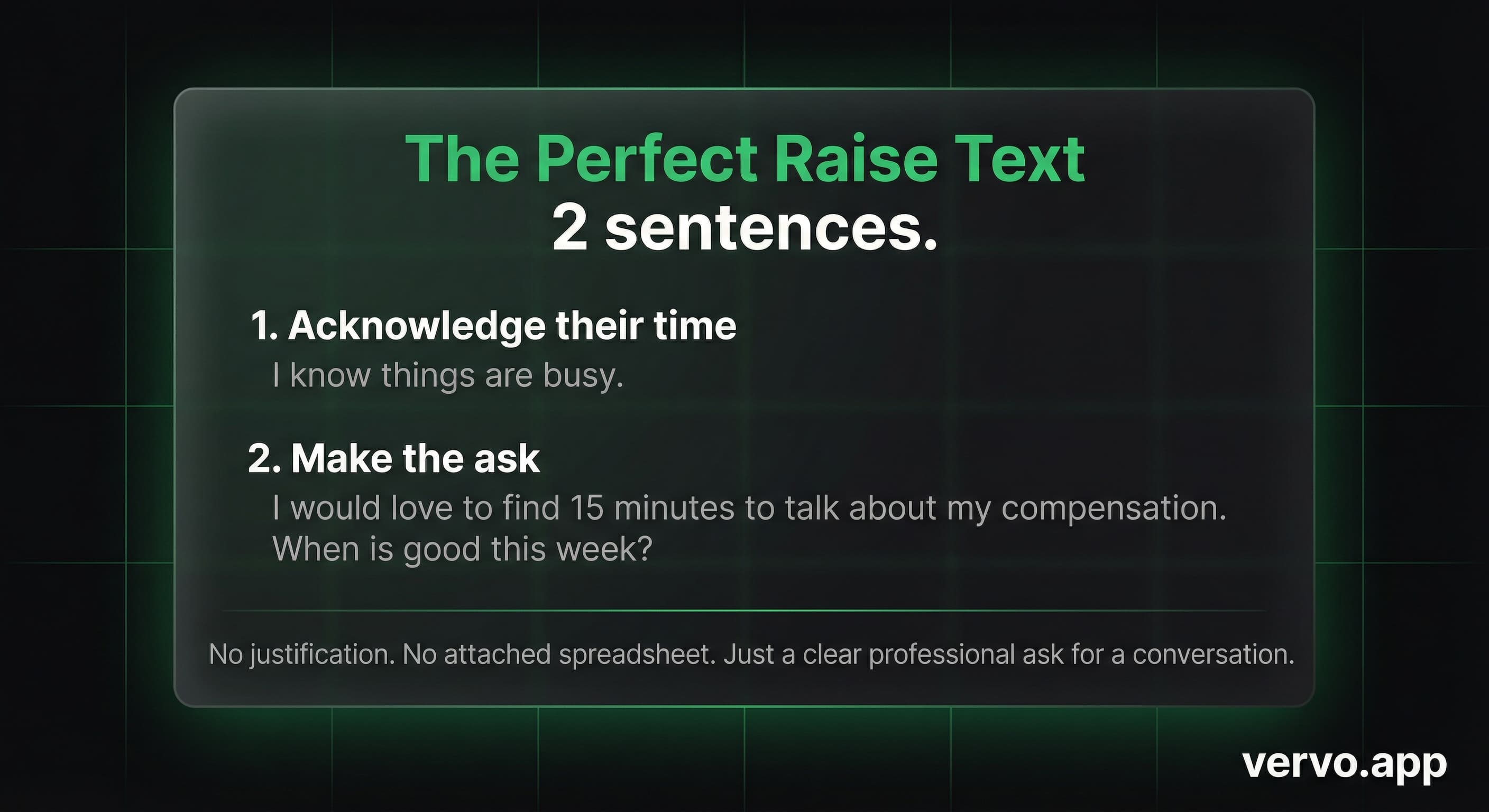
Keep it short. Two sentences is the sweet spot. One sentence acknowledges the reality of their time. The second sentence makes the ask.
Here's a template that works:
That's it. No justification. No attached spreadsheet. No "I've been here for two years and I feel like..." in the first message. Just a clear, professional ask for a conversation.

Here's what NOT to send:
That's what anxiety looks like in text form. Long, hedging, apologetic, burying the ask in qualifiers. Your boss reads that and thinks "this person isn't sure they deserve it." Don't give them that out.
If you struggle with how to text your boss in general, this is a good test case. Keeping it professional without being stiff. Direct, respectful, and brief. That's the formula.
What If They Say No Over Text?
This is where people spiral. You put yourself out there. You got a "not right now" or a "budgets are tight" or a "let's revisit in Q3."
Do not -- I cannot stress this enough -- send a paragraph. Do not justify. Do not argue. Do not make it weird.
Here's what you say:
That's it. You've acknowledged the no, you've established a timeline, and you've kept the door open. You haven't burned anything. You've shown maturity.
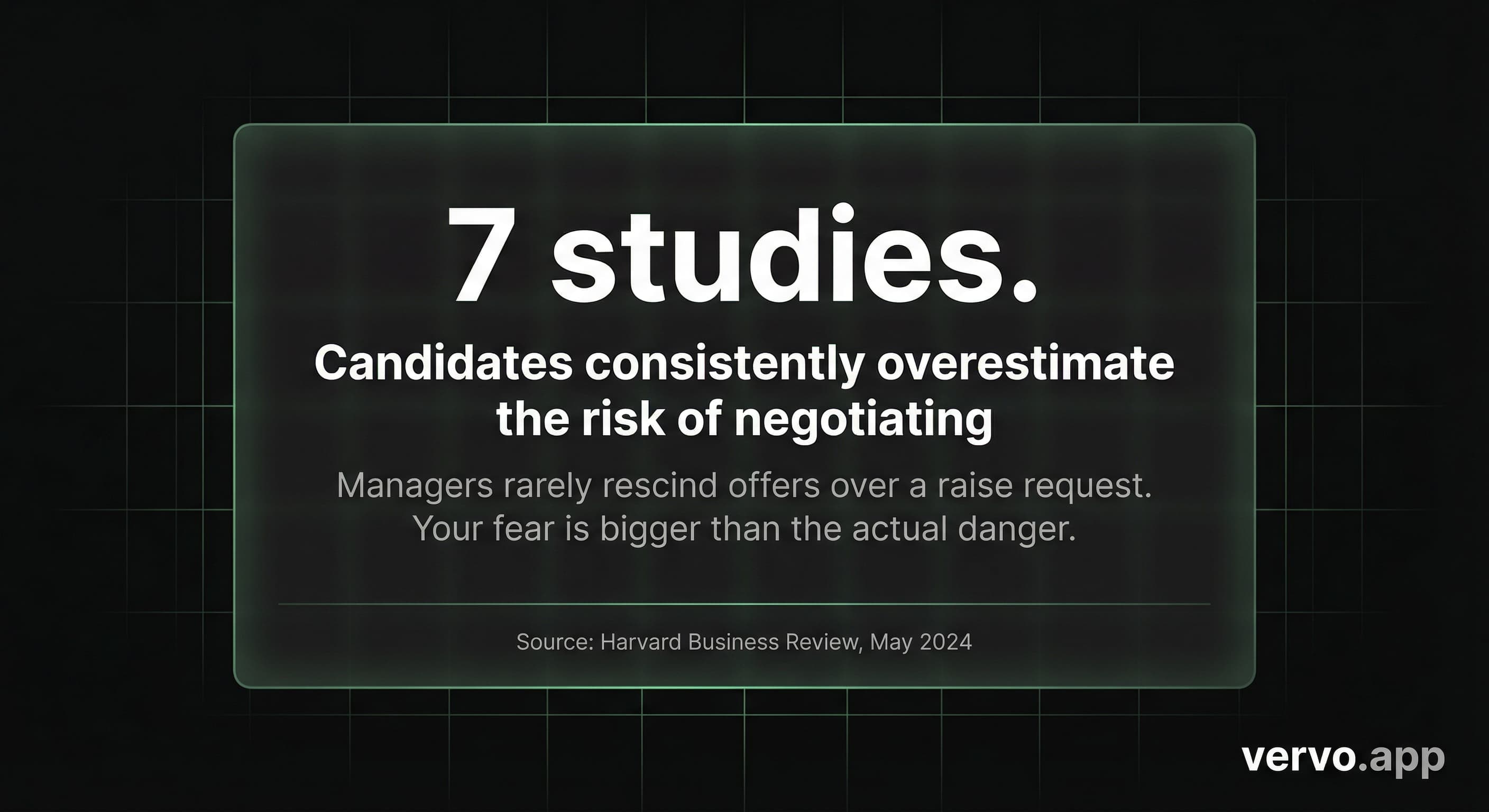
And here's the thing that Harvard Business Review research confirmed in 2024: negotiating almost never costs you the job. Across seven studies, candidates consistently overestimated the risk. Managers rarely rescind offers or tank relationships over a raise request. Your fear is bigger than the actual danger.
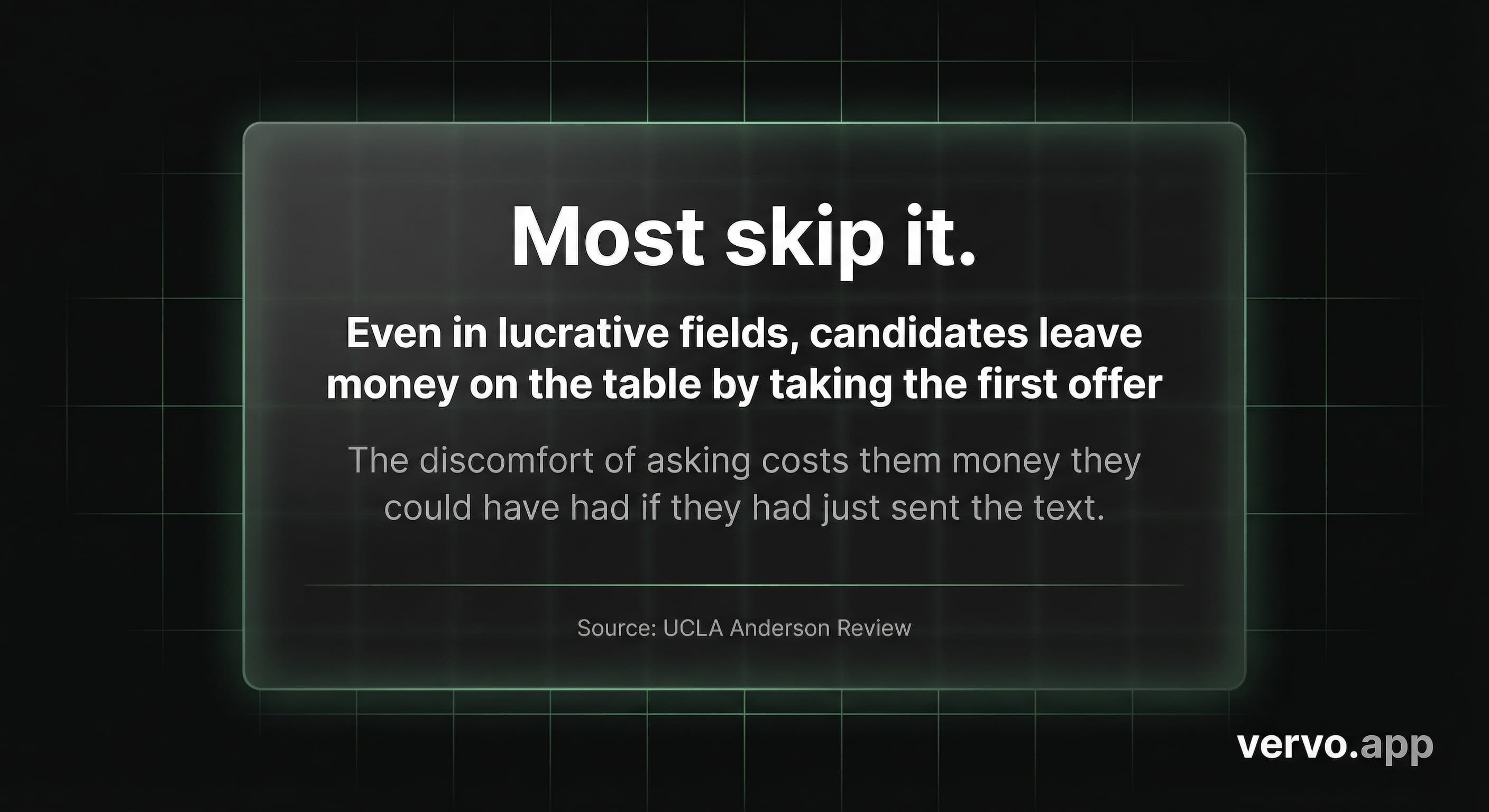
The UCLA Anderson Review found something similar. Most professionals skip negotiation entirely and pay a real price for it. The discomfort of asking costs them money they could have had if they'd just sent the text.
What If Your Boss Only Communicates Over Text?
Some people have bosses who are allergic to meetings. Every conversation happens in Slack, or iMessage, or WhatsApp. The phone never rings. The calendar stays empty.
If that's your reality, you may need to have the full compensation conversation in writing. That's not unprofessional. It's the medium your workplace operates in. But the structure changes.
Instead of a two-sentence opener, you write a short, clear message that lays out:
- What you've accomplished
- What's changed about your role
- What you're asking for
Keep it under 150 words. Bullet points are fine. Don't attach a document unless they ask for one.
Example:
That's direct. It's specific. It makes an ask without being aggressive. And it gives your boss an easy on-ramp to respond.
The Fear Is Bigger Than the Risk
Here's what I know from watching people avoid this conversation for months: the anticipation is worse than the moment.
You imagine your boss getting offended. You imagine awkwardness. You imagine being told no in a way that makes coming to work feel weird. And so you don't send the text. You wait. You hope they'll notice and offer on their own.
They won't. Not because they don't value you, but because no one is tracking your compensation as closely as you are.
The Harvard Program on Negotiation research confirms what anyone who's been on both sides of the table already knows: asking doesn't make you look greedy. It makes you look like someone who knows their worth. The people who don't ask aren't seen as humble. They're just underpaid.
If you're stuck on the wording. If you've been drafting and deleting for an hour, try screenshotting your last conversation with your boss and seeing what Vervo suggests. Sometimes seeing a few options breaks the paralysis. The important thing is that you send something. Imperfect and sent beats perfect and sitting in your drafts.
You deserve the raise. Now send the text.
Sources
- Harvard Business Review, "Research: Negotiating Is Unlikely to Jeopardize Your Job Offer," May 2024
- UCLA Anderson Review, "Most Job Seekers Skip Negotiation -- and Pay a High Price"
- Harvard Program on Negotiation, "Salary Negotiations: Reducing Gender and Racial Pay Gaps"
- ZeroBounce, "Gen Z at Work -- The 2025 Report"