Gen Z Work Ethic: You're Not Lazy, You're Just 18 With 3 Jobs and a Chemistry Final
The real talk guide to Gen Z work ethic in 2026. Why calling out isn't laziness, how to keep communication open at work, and what managers get wrong about young workers.
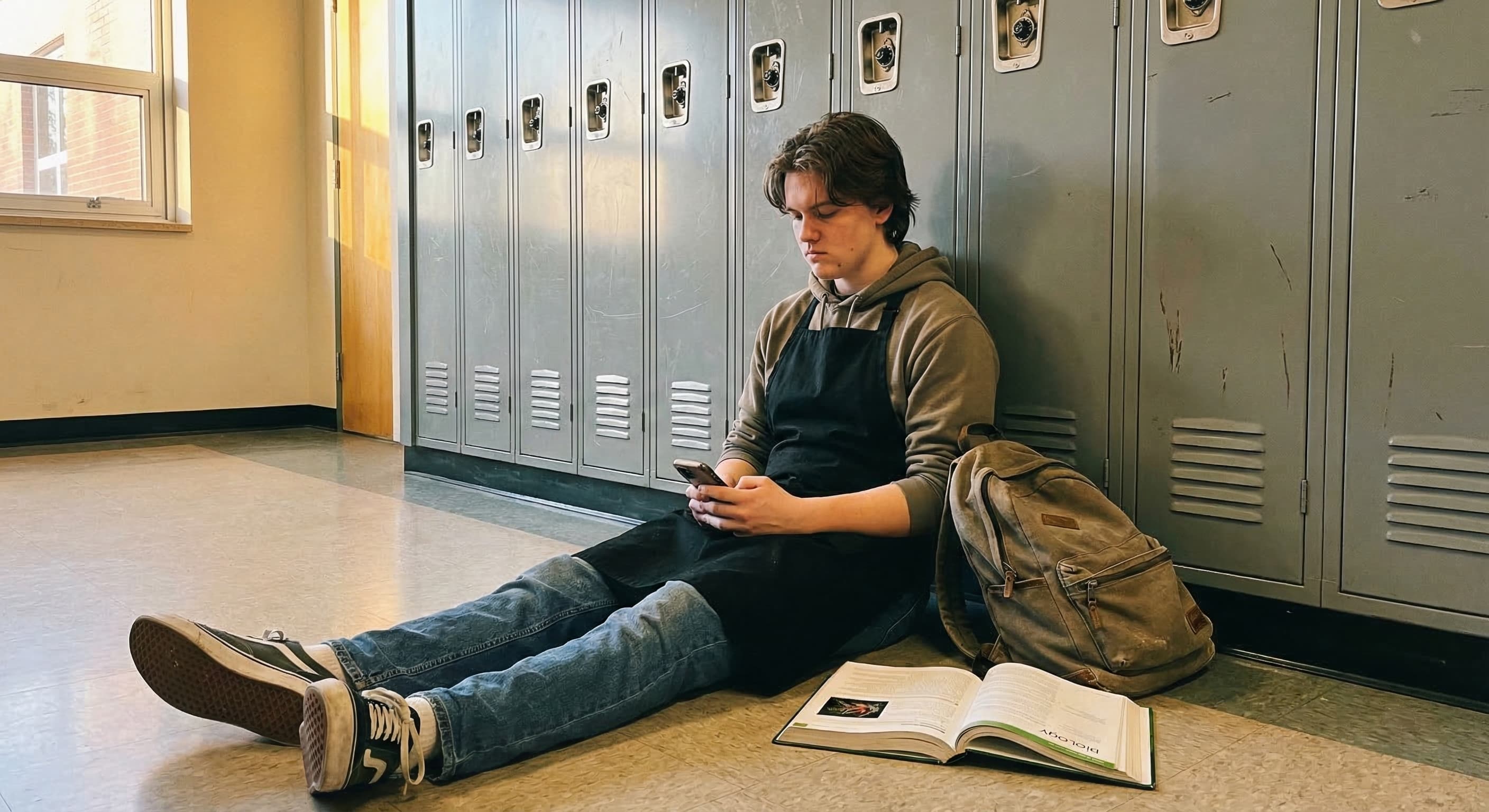
Let's get something out of the way. If you are 18 years old, finishing your senior year, working a closing shift at Chipotle three nights a week, studying for the SAT, maintaining a social life that exists primarily through group chats, and someone calls you lazy -- that person has amnesia about what being 18 actually feels like.
This article is for you. And it's also for the manager who's about to write "Gen Z has no work ethic" in a Slack message to another manager while sitting in a meeting that could have been an email.
We're going to talk about what work ethic actually means in 2026, why the stereotypes are mostly wrong, and how both sides can keep communication open without anyone getting fired or crying in the walk-in freezer.
Why does everyone think Gen Z is lazy?
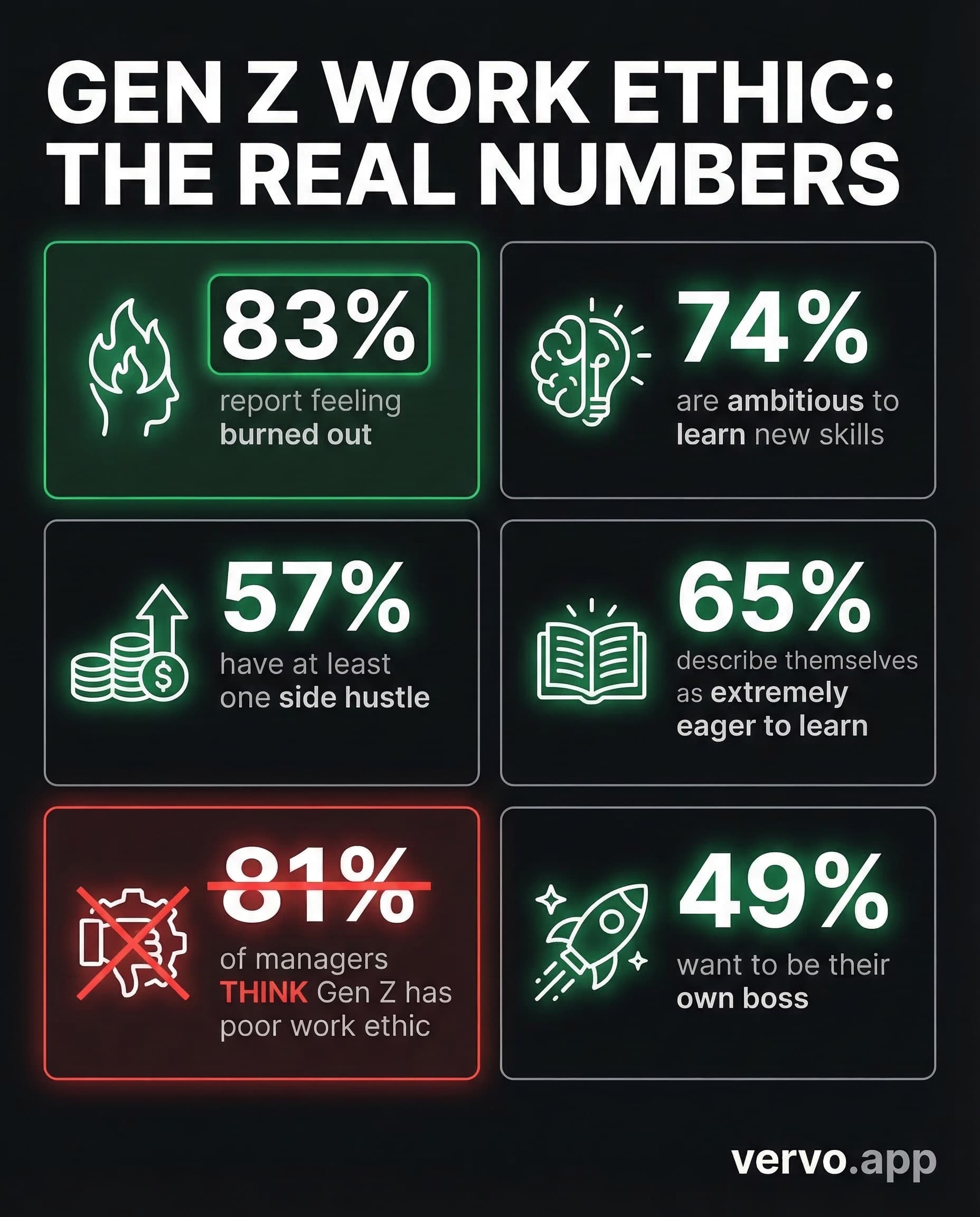
Because 81% of managers told a survey they think Gen Z has poor work ethic. That's a real number from a real 2025 ResumeTemplates study. Eighty-one percent. You'd think Gen Z was showing up to work in pajamas and refusing to make eye contact.
Here's what's actually happening. Older generations defined work ethic as: show up early, stay late, don't complain, be grateful you have a job. That definition worked when a single income could buy a house and a college degree didn't cost more than a car.
Gen Z is operating in a completely different economy. Wages haven't kept up with inflation. 48% of Gen Z doesn't feel financially secure. The average 2026 college grad takes 6 to 9 months to find a job in their field. And 38% end up in roles that don't even use their degree.
So when a 19-year-old working retail asks "why should I give 110% to a company that schedules me 39 hours so they don't have to give me benefits" -- that's not laziness. That's math.
What does being 18 and working actually look like in 2026?
Here's the schedule nobody talks about when they complain about young workers.
Monday through Friday:
- 7:00 AM -- Wake up
- 7:45 AM -- School starts
- 3:15 PM -- School ends
- 3:30 PM -- Drive to work (if you even have a car)
- 4:00 PM -- Shift starts
- 9:00 PM -- Shift ends
- 9:30 PM -- Get home, eat whatever's fast
- 10:00 PM -- Homework, study, try to exist as a human
- 12:30 AM -- Sleep (maybe)
- Repeat
Saturday: Work 8 hours. Attempt to see friends. Fail.
Sunday: Homework catch-up. Laundry if your mom reminds you. Existential dread about Monday.
Now add: college applications, extracurriculars that colleges require, a phone full of texts you haven't answered because you physically don't have time, and the general emotional chaos of being a teenager.
If that person calls out sick one Tuesday because they slept three hours and feel like they got hit by a bus -- maybe the appropriate response isn't "kids these days."
Is calling out actually a problem or are we just not talking about it right?
Here's where communication breaks down.
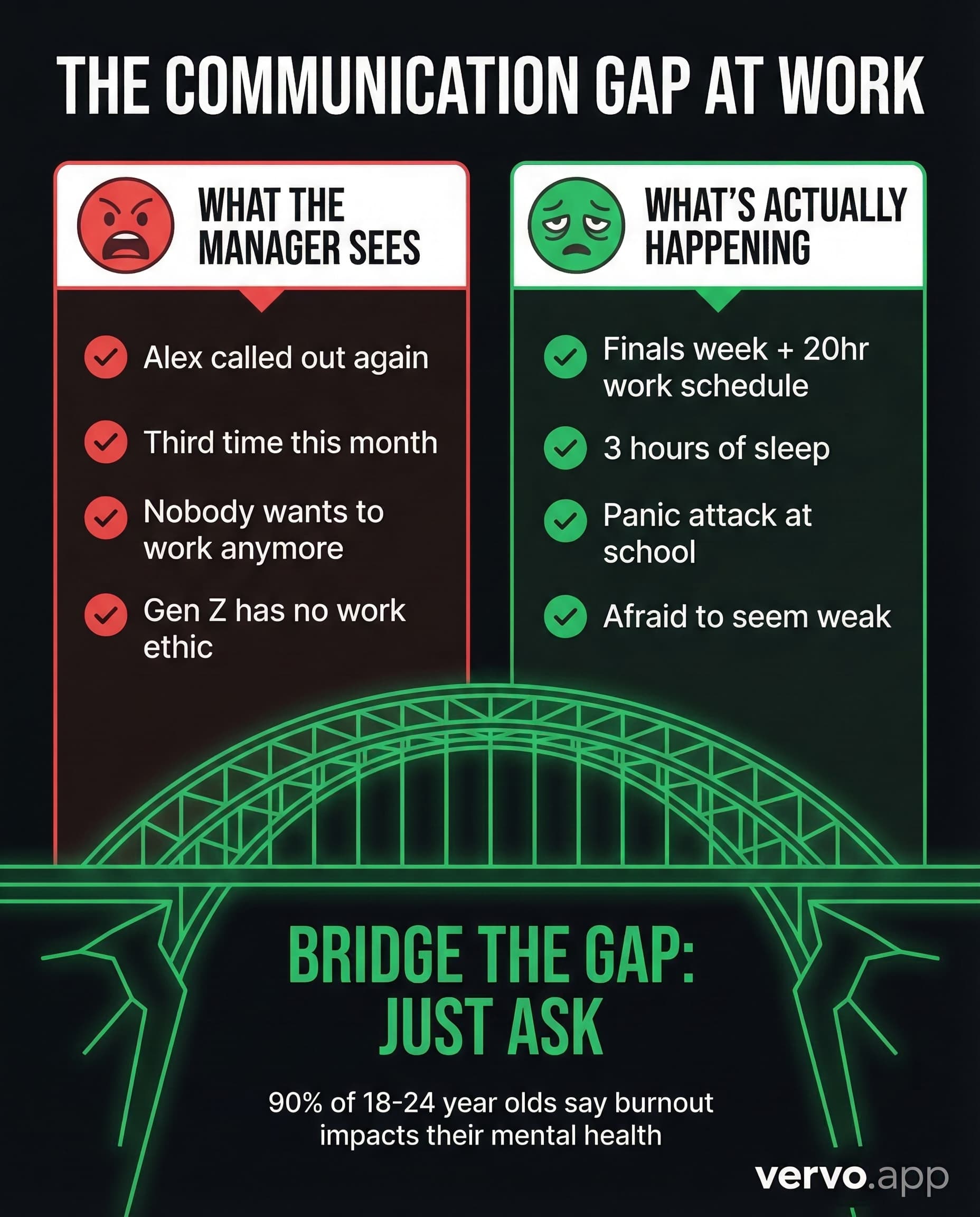
What the manager sees: "Alex called out again. Third time this month. Nobody wants to work anymore."
What Alex is dealing with: Finals week, a 20-hour work schedule on top of a full class load, three hours of sleep, and a panic attack in the school bathroom that they haven't told anyone about because they don't want to seem weak.
The problem isn't that Alex called out. The problem is that nobody asked Alex how they're doing before it got to the calling-out stage.
90% of 18-to-24-year-olds say burnout impacts their mental health. Not "mild inconvenience" -- actual mental health consequences. And instead of talking about it openly, most young workers just silently push through until they can't, then text their manager "hey sorry can't come in today" and feel guilty about it for a week.
How to call out without burning bridges
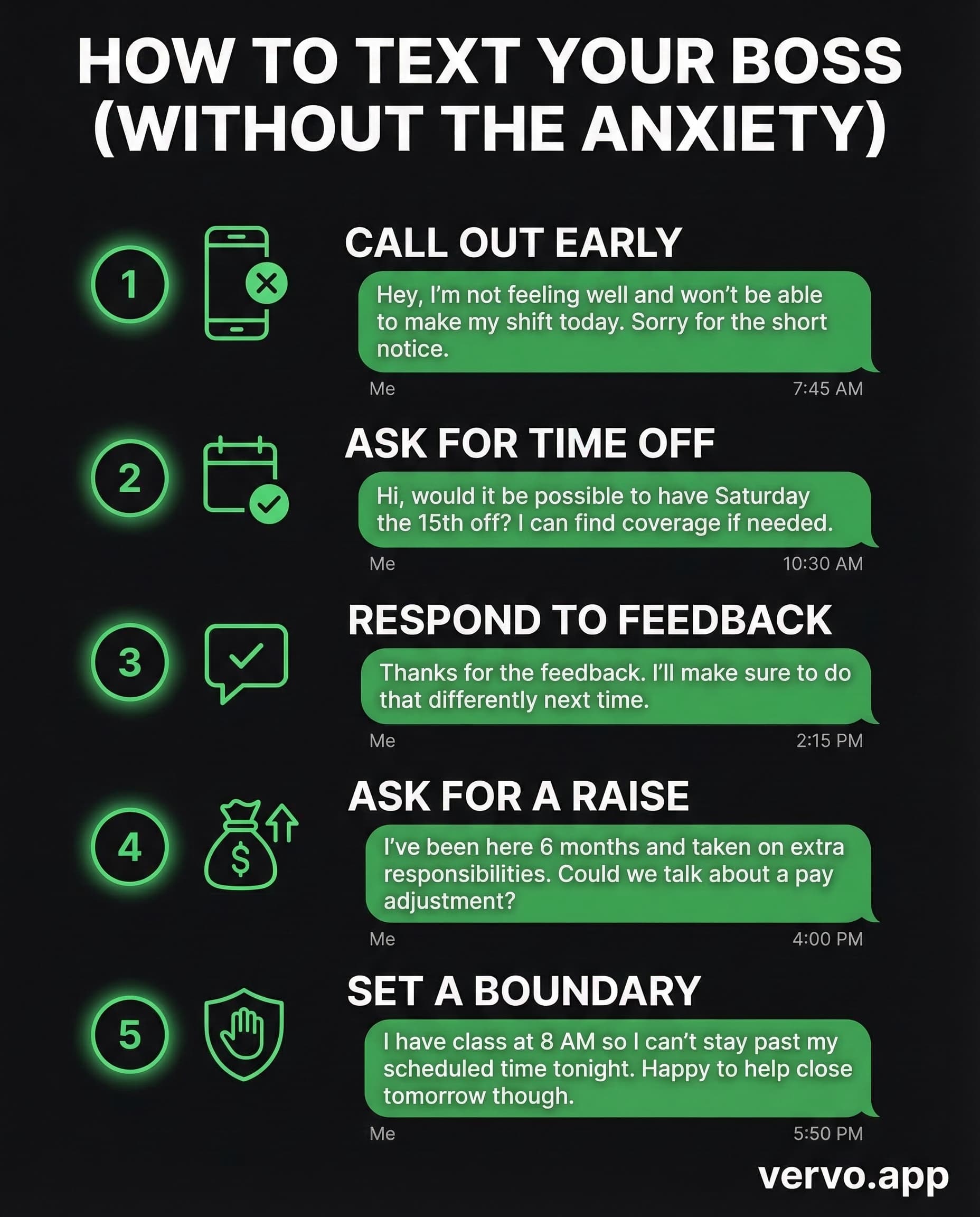
Look, sometimes you genuinely need a day off. Here's how to handle it like a grown-up without writing a five-paragraph essay about your symptoms:
- Text or call as early as possible. Not 10 minutes before your shift. The earlier you communicate, the less stress you put on your team.
- Keep it simple and honest. "Hey, I'm not feeling well and won't be able to make my shift today. Sorry for the short notice." That's it. You don't owe anyone your medical history.
- Offer a solution if you can. "I can try to find someone to cover" goes a long way.
- Don't ghost. The worst thing you can do is just not show up and not say anything. That's not a Gen Z problem -- that's a communication problem.
And for managers: if someone calls out, say "feel better" and figure out coverage. Save the lecture for a pattern, not a single absence. The fastest way to lose a good young worker is to make them feel guilty for being human.
What Gen Z actually brings to the table (that nobody talks about)
While everyone's busy complaining, here's what Gen Z workers are actually doing:
They're hustling harder than any generation before them. 57% have at least one side hustle. 29% manage three or more income streams simultaneously. They're not avoiding work -- they're diversifying it because they watched their parents get laid off from "stable" jobs.
They're learning constantly. 65% describe themselves as "extremely eager to learn." 74% want to develop new skills. They don't want to coast. They want to grow. They just don't want to grow in a place that treats them like a replaceable part.
They're more entrepreneurial. 49% say their primary motivation for side hustles is to be their own boss. 80% of Gen Z business owners started online. One in three earns money using AI tools. They're not waiting for permission.
They care about doing things right. Research shows a 120% increase in being detail-oriented compared to earlier generations. A 100% increase in desire for best practices. They actually care about quality -- they just need someone to show them the ropes instead of expecting them to figure it out while being yelled at.
How to keep communication open (for managers)
If you manage anyone under 25, here's the cheat sheet that actually works.
Stop confusing availability with loyalty
Just because someone doesn't want to stay two hours past their scheduled shift doesn't mean they don't care. It means they have a life outside of work. So do you.
Give feedback in real time, not once a year
Gen Z grew up with instant notifications. They don't want to wait until an annual review to find out they've been doing something wrong for eleven months. Quick, casual check-ins work. "Hey, nice job handling that rush" or "Next time, try this approach instead" -- five seconds, massive impact.
Ask before you assume
If someone's performance dips, the old-school move is to assume they're slacking. The 2026 move is to ask: "Hey, I noticed you've seemed off this week. Everything okay?" You'd be amazed how often the answer is "actually, I'm dealing with something" and how much that one question changes the relationship.
Explain the why
"Do it because I said so" stopped working in approximately 2008. Gen Z will absolutely do hard, boring, unglamorous tasks -- but they want to know why it matters. "We need to restock the shelves by 6 because the morning crew can't serve customers and restock at the same time" is ten times more motivating than "just do it."
Respect their time
If you schedule someone until 9 PM, don't consistently keep them until 9:45 and act like it's no big deal. They might have class at 8 AM. They might have a second job. They might just want to go home and decompress. All of those are valid.
How to communicate better at work (for Gen Z)
Alright, now the part where I talk to you directly. Because this isn't just a managers-need-to-change situation. You have a role in this too.
Show up with words, not just vibes
The number one complaint managers have about Gen Z isn't actually laziness -- it's communication. When you need something, say it. When you're overwhelmed, say it. When you don't understand a task, ask. "I didn't want to bother anyone" is how small problems become big ones.
Your phone is a communication tool, not just a scroll machine
You're the most digitally connected generation in history. Use that skill at work. A quick text update to your manager about a task goes further than you think. Overcommunicate, especially early on. It builds trust fast.
Separate your work texts from your personal texts
This is where it gets real. The same anxiety you feel about texting your crush back can show up when you need to text your boss about a schedule change. Different stakes, same freeze.
If you've ever stared at your phone for 15 minutes trying to figure out how to tell your manager you need a day off, or how to ask for a raise, or how to respond to a passive-aggressive "per my last text" -- you're not alone. 31% of people experience daily texting anxiety, and work texts are some of the most stressful ones.
Tools like vervo.app exist specifically for moments like this. Screenshot the conversation, get three reply options across different tones -- professional, casual, direct -- and pick the one that sounds like you but better. It's not about replacing your brain. It's about getting unstuck when the words won't come.
Don't just quit -- have the conversation first
46% of Gen Z say they're considering leaving their job within the next year. Before you do, ask yourself: did I actually tell anyone what's bothering me? A lot of fixable problems look like dealbreakers when nobody's talking.
The real talk about work ethic in 2026
Work ethic doesn't mean suffering in silence. It doesn't mean being available 24/7. It doesn't mean smiling while someone disrespects your time.
Work ethic means: when you're at work, you work. You do what you said you'd do. You communicate when things change. You treat the people around you with basic respect. And you try to get a little better at your job every week.
That's it. That's the whole thing.
Every generation redefines what work looks like. Boomers fought for weekends. Gen X normalized job-hopping. Millennials demanded purpose. Gen Z is demanding that work fit into a life -- not that life revolve around work.
None of that is lazy. It's called progress.
The bottom line for everyone
If you're Gen Z: You're not lazy. You're navigating a harder economic landscape than the people judging you had at your age. But you do need to communicate. Don't just ghost your job. Don't bottle everything up until you explode. Learn to say what you need to say -- even when it's uncomfortable. That's a skill that pays off everywhere, from your manager to your group chat to the person you're trying to get to know better.
If you manage Gen Z: They're not the enemy. They're 18. Or 22. Or 25. They're figuring it out, just like you were at that age -- except the cost of living is twice as high and every mistake gets screenshot and posted somewhere. Lead with curiosity instead of criticism. Ask questions before making judgments. And for the love of everything, stop writing think pieces about how "nobody wants to work anymore" while your best young employee is working two jobs and taking night classes.
Communication fixes almost everything. And if you're stuck on what to say -- whether it's to your boss, your coworker, or the person who just sent you the most confusing text of your life -- vervo.app can help you find the words. Five free replies a day. No keyboard access. No judgment.
Just like this article.